
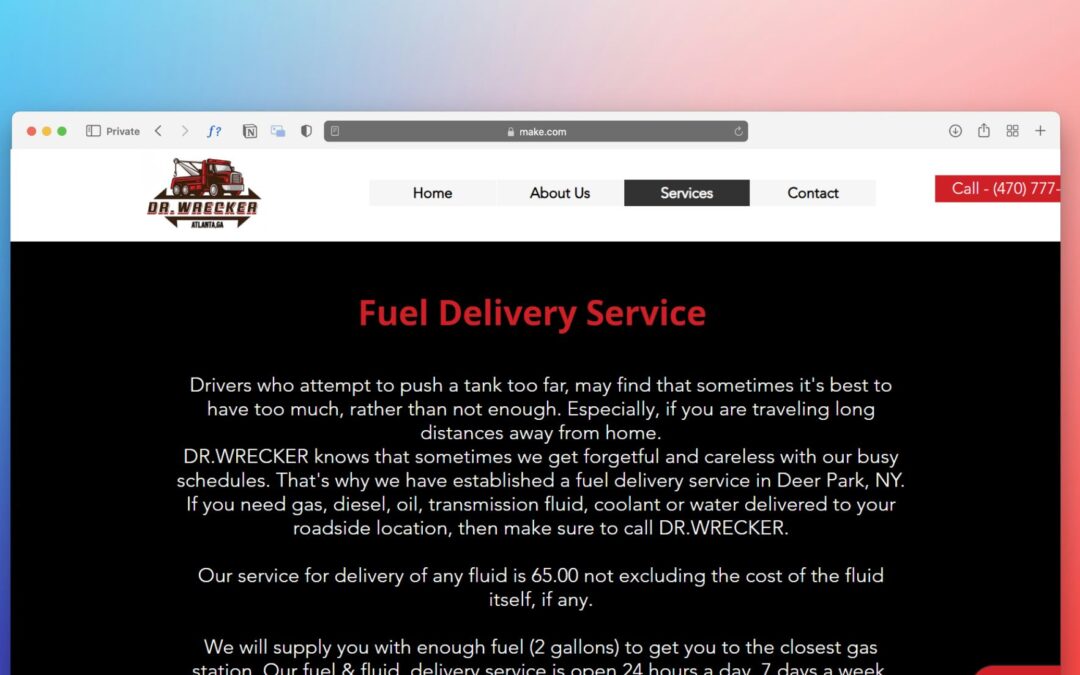
How a Professional Towing Website Can Multiply Your Towing Leads and Boost Your Business
Building a good towing web site requires critical planning, designing and effective placement of features that do not only project the towing business professionally but also turn the visitors into quality leads. A powerful towing web site can be turned into an effective marketing instrument which will attract the interest of the target clientele, give them convenient access to the needed data, and motivate them to make direct contact which will lead to a rise in leads and cash calls.
Significance of a powerful Towing Web Site in Lead Generating.
A well designed towing web site has been created as an online store front that is open 24/7 to anyone seeking towing service in the locality. Beyond the services that are displayed in a good site, a robust site is an essential part of lead generation because of the enhanced user experience and internet presence. As a great majority of the customers resort to their smartphones in case of any emergency, a mobile-friendly site means that the user will find the business and connect with it within a minute. Besides, search engine optimization (SEO) makes your web site have a high ranking in local search engines so that you can have more organic traffic of individuals who are actively interested in towing services.
10 Must-have Items to consider when creating a web site to promote a towing company.
1. Mobile-Responsive and Friendly Design.
Towing websites cannot afford not to be mobile-friendly. Towing services are usually demanded in case of an emergency when an individual is on the move hence users normally visit websites using their smartphones. The site should be viewable on all size screens and devices without zooming or horizontal scrolling up. Responsive also implies that the site has automatic layout, font size, and navigation menus to enhance smooth and friendly user experience.
This design factor is very essential in organic visibility since Google favours mobile friendly websites in searches. The risk of losing a potential customer to a company with a site that is easily accessible on mobile devices is too big and the company may lose. Also, the mobile specifics, such as the ability to call a towing service with a button press can make it easier to call the towing service on a mobile phone
2. Easy to Find and Noticeable Contact information.
The availability of contact information is very important in a towing site, where the urgency of the customers is a determining factor. A large phone number should be on every page, and preferably have the click-to-call option when opening it on a phone to help customers get in touch with a touch of a button. The presence of an email-address, physical address in case of a real-life store, and a simple contact-form will provide various ways of communication, and it addresses both urgent and not so urgent questions.
Showing business hours and availability of 24/7 service as such information is frequently used in decision-making in a case of emergency. Exposing contact information will further enhance the chances of converting a visitor to the website into a customer since there will be no obstacles or confusion in the way of seeking assistance.
3. Strong Calls to Action (CTAs)
The guiding signs driven by calls to action are what guide the users through the site in making the contact or getting service. Good CTAs are supposed to be clean, persuasive and strategically located all over the site. There are such buttons as Call Now, Request a Tow, or Get a Free Quote that attracts visitors to make an immediate response and become leads.
CTAs must be visually different to the color scheme of the site so that they do not look intrusive. Besides the buttons, have clickable phone numbers and simple to finish forms, which collect the necessary customer data in a very short time. Repeating the CTAs on the high-traffic pages as well as at the logical points of the visitor browsing history maximizes the engagement and facilitates the conversion.
4. Skilled and Unified Branding.
A towing site needs to be visually accurate of the reliability, trustworthiness, and professionalism with regular utilization of logos, color scheme, fonts, and imagery. The design must reflect the identity of the brand so that the business becomes recognizable. A nice logo that is placed high, mostly in the header, creates brand awareness and makes the customers not to forget the towing brand.
The use of branding in all the pages also gives the visitor some assurance that he or she is dealing with a serious and legitimate business. Professional photographs of the company trucks, staff, and services should be used as opposed to representing general stock photographs, which is more credible and personal contact with the potential customers.
5. Detailed Service Pages
Providing a list of all services and describing them in detail make the customers aware of what exactly the towing business offers and make them trust the possibility to receive what they need specifically. Each of the main services, flatbed towing, roadside assistance, emergency recovery or vehicle transport, should have its own page or section with a description of the process, its advantages, and any special equipment.
The description of services should also be well-written and this contribution enhances the process of search engine optimization since the website will be ranked on a wider array of relevant keywords. FAQs can also be included in relation to every service in advance, which can avoid any doubt, and the chances of visitors contacting the company with their towing services are higher.
6. Search Engine Optimization (SEO)
SEO makes sure that the site ranks highly in the search result list, which enhances the organic traffic of the local users who are searching towing services. SEO would encompass key-word research and incorporation of key words such as towing service near me, 24 hour towing and location targeted key words. To optimize the indexing of search engines, optimized page titles, meta description, header tags and image alt text help.
The local optimization techniques, including the establishment of a Google My Business account and backlinks in local directories and partners increase the presence of the site in the target geographical region. The constant refreshment of content and creation of blogs with informative information on towing issues can lead to a consistent traffic and leads in the long term.
7. Fast Loading Speed
Speed of the web site has a direct impact on search results and user experience. The towing site should be fast in loading particularly on mobile gadgets as impatient customers will dump the slow loading sites in favor of faster ones. Image optimization, code reduction, caching, and trustworthy hosting services are some of the ways through which the fast page load time is kept.
Rapid loading means that visitors can locate information and request service without wasting the time that is very important in cases of emergency or any other situation where there is a need to save the day. A slow site will be frustrating to users and will result in loss of business.
8. Simple Navigation and User-Friendly Design.
Visitors can have information that they need without wasting time and money on searching. The intuitive nature of the clean navigation menu with clear labels of key pages such as Home, Services, About Us, and Contact makes browsing easy. A search bar should also be included to allow users to get certain information.
The structured design with rational organization of content minimizes the cognitive load, which allows users to grasp the most important information and locate call-to-action buttons with ease. Easy navigation increases general user satisfaction and makes people spend more time on the site, raising the potential of the lead.
9. Customer Reviews and Testimonials.
A positive reputation and trustworthiness of the towing company is enhanced through posting real reviews and testimonials of customers. Social proof usually comes before a purchasing decision is formulated by prospective customers in service industries that deal with trust and reliability such as in the towing industry.
Placement of reviews on the homepage or a special testimonials page, or case studies or before and after pictures, further support the quality and customer satisfaction of the business. The addition of such outside reviews as Google or Yelp provides some credibility and assists with local search.
10. Google Maps and Location-Based Functionality Integration.
The presence of an interactive map that will allow customers to visually verify the area of coverage and locate the business location easily will add value to the service. It can be integrated with Google Maps and lets the visitor get their way easily. Location-specific keywords and features make the site location-specific search and improve the experience of the users by displaying a nearby coverage on the map.
This will minimize the misunderstanding of limits of the services and will give customers a promise that assistance is close, which may make them trust the towing company more and have the urgency to call it.
The combination of these ten components produces an effective towing site that is strong enough to attract, engage, and turn visitors into leads. The properly constructed site containing such features becomes a branding engine and also a lead generating machine which will assist the towing business to expand by attracting customers at a time when they require services.
The main advantage of investing in a professionally designed, strategically planned website that will be created specific to the unique requirements of the towing industry is the online presence, competitive edge, and the high probability of obtaining valuable leads in the online market.
All these combined together make a towing site an essential asset to business development in a sustainable manner.